 Seal Beach Golf Cart Repair
 Mobile Golf Cart Repair in Seal Beach
Seal Beach Golf Cart Repair brings the shop to your cart. A technician arrives at a scheduled window anywhere in Seal Beach, Leisure World, Rossmoor, Los Alamitos, Huntington Beach, Sunset Beach, or the southeast side of Long Beach, runs a full diagnostic on the cart where it sits, quotes a flat price on the spot, and finishes most repairs in that same visit. The $75 to $125 service call includes the diagnostic and is applied toward the repair. No trailer, no drop-off, no wait list.
This is the core service, and everything else on the site (batteries, cables, brakes, chargers, motors, tune-ups, street-legal equipment) is a specialty of it. Here is what a visit involves and why it works better than the alternative on this stretch of coast.
Why mobile is the right model for Seal Beach
A golf cart that will not move is the hardest vehicle you own to get to a shop. It weighs 900 to 1,100 pounds with a lead-acid pack in it, it does not fit in an SUV, and if it will not roll under its own power you need a trailer, a winch, and a second person just to load it. Inside a gated community the problem compounds: the cart lives on a parking pad, the owner may no longer drive a car, and the shop is a trailer ride away.
Seal Beach makes that wait expensive in a way most cities do not. The 2020 Census counted 25,242 residents with a median age of 60.8, and 43.2 percent of the city is 65 or older. Leisure World alone houses about 9,500 people in 6,608 units on 531 acres, roughly 40 percent of the city, with an average resident age of 74 as of 2019. Its streets are the only ones in Seal Beach where a golf cart is legal, designated under Municipal Code 8.45.045, and for thousands of residents the cart is the short-trip vehicle: to the golf course at 7:30 in the morning, to one of the five clubhouses, to the health center, to the shopping center outside the gate. When the cart is down, a piece of daily life is down with it.
So we built the service to come to you, with the parts already on the truck.
What the truck carries
- Battery sets in the common configurations: six 6V (36V carts) and six 8V or four 12V (48V carts)
- Full cable sets, cable ends, terminal hardware, and anti-corrosion coating, because on the coast this is the most-used bin on the truck
- Solenoids, fuses, and main cables for Club Car, E-Z-GO, Yamaha, ICON, and Evolution
- Brake shoes, drums, cables, and hardware
- Tires in standard sizes, with a portable changer and balancer
- Belts, brushes, and bearings for common motors
- LED light kits, turn signal and horn kits, mirrors, and wiring for decal and LSV equipment
- A load tester, hydrometer, multimeter, and charger test rig
That inventory is why most calls finish in one visit. If your cart needs a controller or a motor we do not stock, we order it and come back once, usually within a few days, with no second trip charge.
The diagnostic, in the order we run it
Every visit starts the same way, because the three most expensive mistakes in cart repair all come from skipping steps, and on the coast one step matters more than anywhere else.
- Load test each battery individually. Not the pack, each battery. A six-battery string is only as strong as its weakest member, and one failed battery pulls the whole pack down to its level. On a young pack, replacing that one battery is the fix; on an old pack, it is not, and we say which.
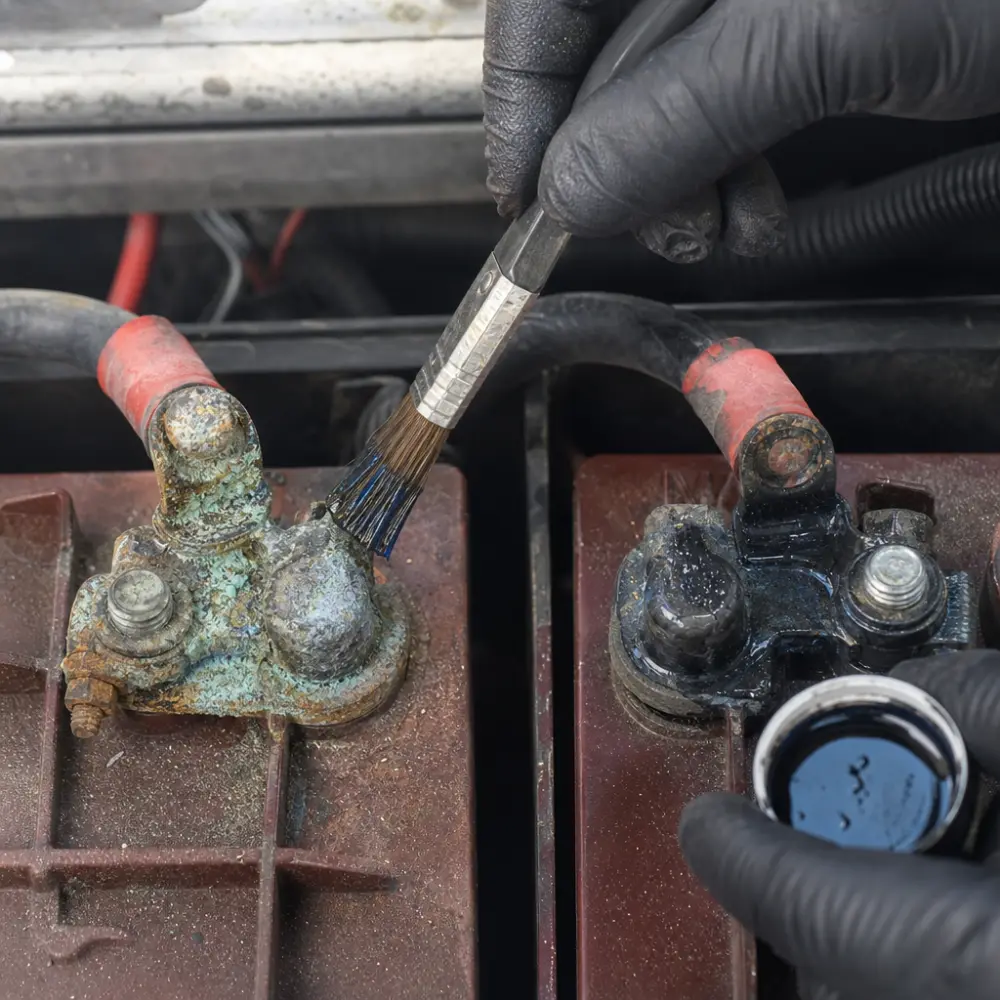
- Voltage drop across every cable and terminal, under load. This is the coastal test. With the cart pulling real current, we read the voltage lost across each cable end and terminal. A clean connection loses almost nothing; a connection corroded by salt air loses a measurable fraction of a volt, and six or eight of those in series starve the motor and undercharge the pack. It takes five minutes and it separates a $150 cable job from a $1,500 battery pack. See corroded terminals and cables.
- Pack voltage under load. A pack that reads 50 volts sitting still and sags to 40 under load is telling you something a resting reading hides.
- Hydrometer, cell by cell, on flooded packs. Specific gravity tells us whether a battery is discharged, sulfated, or has a dead cell, which the voltmeter alone cannot.
- Charger output at the plug, and a look inside the charge port. A charger that turns on but delivers low current starves a healthy pack and imitates battery death perfectly. Green or pitted pins in the port do the same. See charger repair.
- Solenoid and controller. A click with no motion, no click at all, or a cart that surges each point to a different part of the drive system. We test throttle input, solenoid contacts, and controller output before anything gets condemned. See motor and controller repair.
You get the findings in writing whether or not you approve the repair.
What the coast does to a cart
Every cart in our service area lives within a few miles of the Pacific, and the carts in Leisure World, Sunset Beach, Huntington Harbour, and Naples live within a mile or two of open salt water. Airborne salt settles on every bare metal surface, pulls moisture out of humid air, and holds a salty film against the terminals, cable lugs, charge-port pins, and brake hardware. NASA runs its main corrosion laboratory on a beach at Kennedy Space Center, which it calls one of the most corrosive places in North America, and its long-term study measures corrosion rate against distance from the ocean at sites from 150 feet to five miles out, because distance from the surf is the variable that matters. Our whole service area sits inside that band.
The marine layer keeps the film wet. NOAA’s 1991 to 2020 normals for Long Beach Airport put average relative humidity at 67 percent for the year and near 70 percent in June and September, and marine-layer clouds peak at dawn most summer mornings before burning off. What the coast does not do is cook batteries: the August average high at Long Beach Airport is 83.2 degrees, close to the 80 degrees Trojan says optimizes lead-acid life. Packs here die of chronic undercharging through bad connections, not evaporation, which is why the tune-up service is built around corrosion rather than watering.
Street carts and the rules
Under Seal Beach Municipal Code 8.45.045, every cart or LSV on Leisure World streets needs working headlights, brake lights, and directional signals between dusk and dawn, and Seal Beach police treat any cart that fails the Vehicle Code 345 test (two seats, under 1,300 pounds, 15 mph) as a low-speed vehicle needing the full equipment list. A lot of mobile calls inside the gates are exactly that: a light circuit that quit at a corroded connector, a horn that stopped, a parking brake that creeps. We treat lighting and brake work on a street cart as safety work. The compliance page prices every item.
Common calls, and what they usually are
| What you tell us | What it usually is | Typical cost |
|---|---|---|
| Clicks but will not move | Solenoid contacts, or a corroded cable under load | $100 to $275 |
| No click, no movement | Fuse, key switch, cable, or controller input | $100 to $350 |
| Will not charge | Charge port, charger, or over-discharged pack | $125 to $850 |
| Short range, bogs under load | Corroded connections, aging pack, or one bad battery | $100 to $1,900 |
| Green or white crust on terminals | Salt-air corrosion | $100 to $250 |
| Surges or jerks | Throttle input, controller, or motor brushes | $150 to $650 |
| Squeal or grab when braking | Corroded drums or cables, worn shoes | $85 to $275 |
| Lights or signals dead | Corroded connector or chafed harness | $100 to $300 |
Every range is on the pricing page, and the repair cost calculator prices any symptom before you write.
Honest limits
We are an independent service, not an authorized dealer or warranty center for any manufacturer. If your cart is still under factory warranty, the selling dealer is the right call for warranty work, and we will say so. We also tell you when a repair does not make sense: a 20-year-old cart with a rusted frame does not need a new battery pack, it needs a straight conversation about what it is worth.
Book a visit
Tell us the brand, how many batteries you count, whether the cart is DMV-registered as an LSV, and what it is doing. A photo of the battery compartment helps more than anything, because on the coast the photo often shows the answer. You get a flat number and a scheduling window, usually same-day or next-day, anywhere in Leisure World, Rossmoor, Los Alamitos, Huntington Beach, Sunset Beach, or Long Beach.
Frequently Asked Questions
What can you actually fix at my parking pad?
Nearly everything a cart needs: battery packs, corroded cables and terminals, solenoids, controllers, motors, chargers and charge ports, brakes, tires, belts, lights, signals, horns, and mirrors. The truck carries the common parts for Club Car, E-Z-GO, Yamaha, ICON, and Evolution, so most jobs finish in one visit. A rare part gets ordered and installed on a quick return trip with no second trip charge.
How does the service call work?
It is $75 to $125 depending on where you are along the coast, and it covers the trip plus a full on-site diagnostic: load test on every battery, voltage drop across every cable under load, charger output, charge-port inspection, solenoid and controller checks. Approve the repair and the fee is applied to the total.
How do you get into Leisure World?
You add us as a temporary visitor for the appointment day, by calling Security or through the Proptia portal. The Main Gate at Seal Beach Boulevard and Golden Rain Road is open around the clock; the St. Andrews and North gates run 8 a.m. to 8 p.m. The tech comes to your parking pad or carport at the scheduled window.
How fast can you get to me?
Same-day or next-day for most calls. Seal Beach, Leisure World, Rossmoor, and Los Alamitos sit within a few minutes of each other; Huntington Harbour, Sunset Beach, and the Naples side of Long Beach are a short drive down Pacific Coast Highway or across the San Gabriel River. A good description of the symptom lets the tech load the likely parts before leaving.
Do you work on gas carts and factory LSVs too?
Yes. Electric carts are the majority on the coast, but gas carts get the same service: starter-generators, belts, carburetors, fuel systems, plugs, and filters. Factory-built low-speed vehicles get the same electrical and brake work plus the lights, signals, and wipers they are required to carry.